You Could Be Shot By the CIA
— Jacob Tyler —
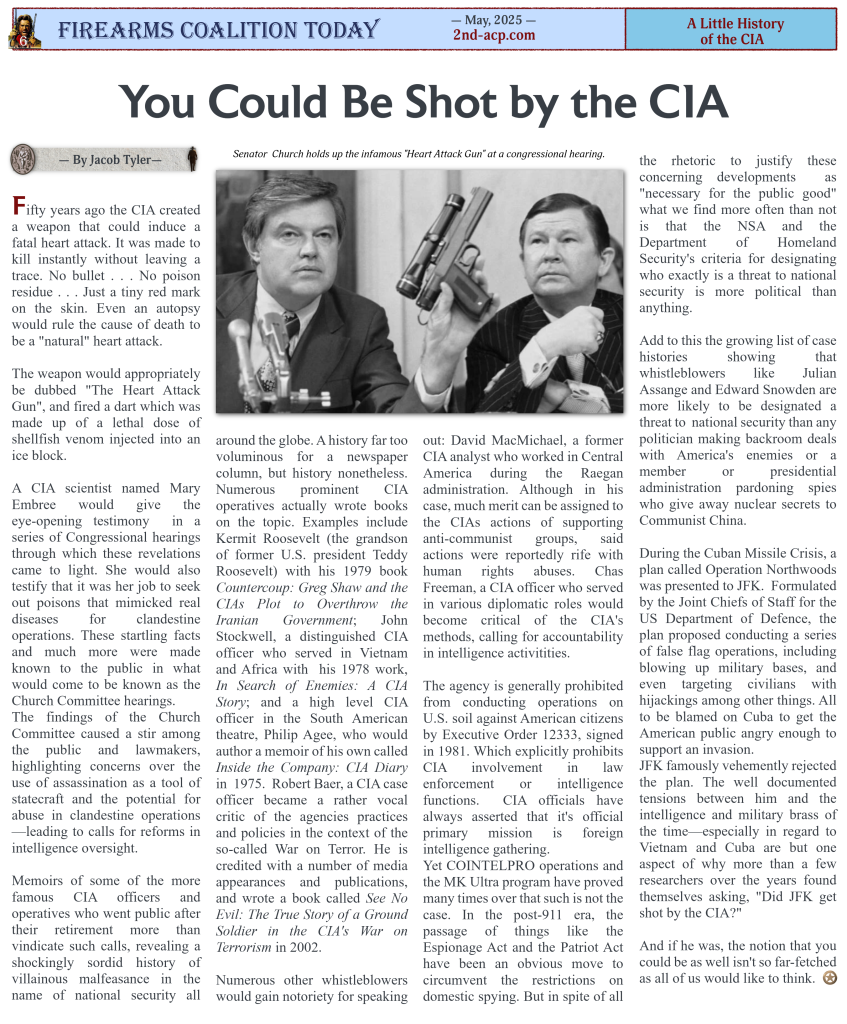
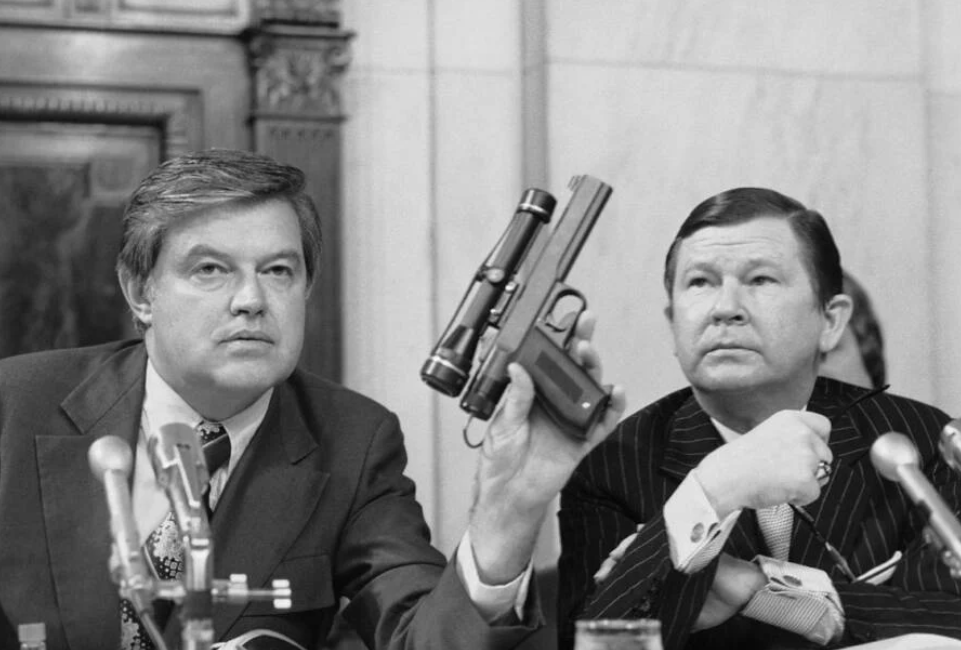
Fifty years ago the CIA created a weapon that could induce a fatal heart attack. It was made to kill instantly without leaving a trace. No bullet . . . No poison residue . . . Just a tiny red mark on the skin. Even an autopsy would rule the cause of death to be a "natural" heart attack.
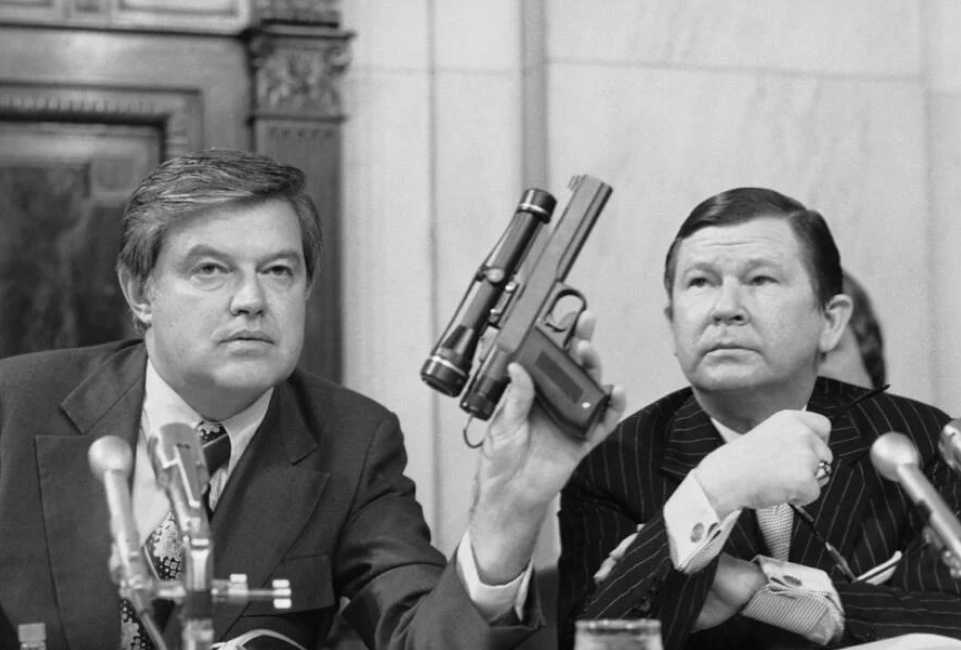
The weapon would appropriately be dubbed "The Heart Attack Gun", and fired a dart which was made up of a lethal dose of shellfish venom injected into an ice block.
A CIA scientist named Mary Embree would give the eye-opening testimony in a series of Congressional hearings through which these revelations came to light. She would also testify that it was her job to seek out poisons that mimicked real diseases for clandestine operations. These startling facts and much more were made known to the public in what would come to be known as the Church Committee hearings. The findings of the Church Committee caused a stir among the public and lawmakers, highlighting concerns over the use of assassination as a tool of statecraft and the potential for abuse in clandestine operations—leading to calls for reforms in intelligence oversight.
Memoirs of some of the more famous CIA officers and operatives who went public after their retirement more than vindicate such calls, revealing a shockingly sordid history of villainous malfeasance in the name of national security all around the globe. A history far too voluminous for a newspaper column, but history nonetheless.
Numerous prominent CIA operatives actually wrote books on the topic. Examples include Kermit Roosevelt (the grandson of former U.S. president Teddy Roosevelt) with his 1979 book Countercoup: Greg Shaw and the CIAs Plot to Overthrow the Iranian Government; John Stockwell, a distinguished CIA officer who served in Vietnam and Africa with his 1978 work, In Search of Enemies: A CIA Story; and a high level CIA officer in the South American theatre, Philip Agee, who would author a memoir of his own called Inside the Company: CIA Diary in 1975. Robert Baer, a CIA case officer became a rather vocal critic of the agencies practices and policies in the context of the so-called War on Terror. He is credited with a number of media appearances and publications, and wrote a book called See No Evil: The True Story of a Ground Soldier in the CIA's War on Terrorism in 2002.
Numerous other whistleblowers would gain notoriety for speaking out: David MacMichael, a former CIA analyst who worked in Central America during the Raegan administration. Although in his case, much merit can be assigned to the CIAs actions of supporting anti-communist groups, said actions were reportedly rife with human rights abuses. Chas Freeman, a CIA officer who served in various diplomatic roles would become critical of the CIA's methods, calling for accountability in intelligence activities.
The agency is generally prohibited from conducting operations on U.S. soil against American citizens by Executive Order 12333, signed in 1981. Which explicitly prohibits CIA involvement in law enforcement or intelligence functions. CIA officials have always asserted that it's official primary mission is foreign intelligence gathering. Yet COINTELPRO operations and the MK Ultra program have proved many times over that such is not the case. In the post-911 era, the passage of things like the Espionage Act and the Patriot Act have been an obvious move to circumvent the restrictions on domestic spying. But in spite of all the rhetoric to justify these concerning developments as "necessary for the public good" what we find more often than not is that the NSA and the Department of Homeland Security's criteria for designating who exactly is a threat to national security is more political than anything.
Add to this the growing list of case histories showing that whistleblowers like Julian Assange and Edward Snowden are more likely to be designated a threat to national security than any politician making backroom deals with America's enemies or a member or presidential administration pardoning spies who give away nuclear secrets to Communist China.
During the Cuban Missile Crisis, a plan called Operation Northwoods was presented to JFK. Formulated by the Joint Chiefs of Staff for the US Department of Defense, the plan proposed conducting a series of false flag operations, including blowing up military bases, and even targeting civilians with hijackings among other things. All to be blamed on Cuba to get the American public angry enough to support an invasion. JFK famously vehemently rejected the plan. The well documented tensions between him and the intelligence and military brass of the time—especially in regard to Vietnam and Cuba are but one aspect of why more than a few researchers over the years found themselves asking, "Did JFK get shot by the CIA?"
And if he was, the notion that you could be as well isn't so far-fetched as all of us would like to think.
This article is part of the first issue of the National Firearms Coalition Today. To Click the image below to order the digital edition from our shop.