The .46-Caliber Air Rifle That Kept Lewis and Clark Out of Trouble
— Warfare History Network —

When one thinks of the guns that won the West, one naturally envisions such familiar weapons as the Winchester, Henry, and Spencer repeating rifles, the trapdoor Springfield, the Smith & Wesson revolver, and the Colt Peacemaker. Thinking back even further, there were the older percussion-cap rifles such as the Hawken buffalo gun or its flintlock predecessors, the Kentucky and Pennsylvania long rifles. Largely unknown to the general public is a singular weapon that never belched out gunpowder or killed a single human being in the United States, but that was perhaps the single most influential weapon in the opening of the American West: the Girandoni air rifle, the secret weapon of the Lewis and Clark expedition.
The rifle was four feet long and weighed 10 pounds. The butt of the weapon was an iron flask that could be detached, pumped full of air, and then refitted to the weapon. Each rifle was issued with three such air reservoirs. The Girandoni was approximately the same length and weight of a conventional musket and was loaded with 22 lead rifle balls that were propelled out of the weapon individually by controlled bursts of compressed air. Fed into a loading tube alongside the barrel of the weapon, these rifle balls were loaded into the weapon individually by a simple steel block, which slid back and forth at the base of the breech. Much like the popular modern-day Daisy Red Ryder BB gun, the rifle balls were fed into the breech with the aid of gravity, the muzzle of the weapon being held upright as the bullets rolled down toward the breech. One crucial advantage to this loading mechanism was the fact that the rifleman, rather than having to stand upright to load, could actually lie on the ground and simply hold the weapon up vertically.
The gun reached a zenith in its development around 1780 at the hands of an enterprising Tyrolean gunsmith named Bartolomeo Girandoni. Produced in .46-caliber, the rifle was a quantum leap forward in weapons technology and would soon be adopted by the Austrian military. Despite its deadly accuracy and firepower, it would prove too great a leap however, for the military minds of the period to handle, and was completely phased out of service by 1810.
It is unclear how the weapon now on display at the Pentagon first came to the United States—possibly it was a surplus rifle that had been phased out of Austrian military service. Whatever its provenance, historians have determined that it was most likely purchased by Captain Meriwether Lewis between May 9 and June 9, 1803, at Isaiah Lukens’ instrument shop just outside Philadelphia. Lewis was en route to Pittsburgh at the time for the final construction and fitting out of the Corps of Discovery’s keelboat. On the very first page of Lewis’ personal journal kept on the trip, he recounts how he demonstrated the weapon’s capabilities to the wonderment of the crowd. The Indians, he said, considered the rifle “something from the gods.”
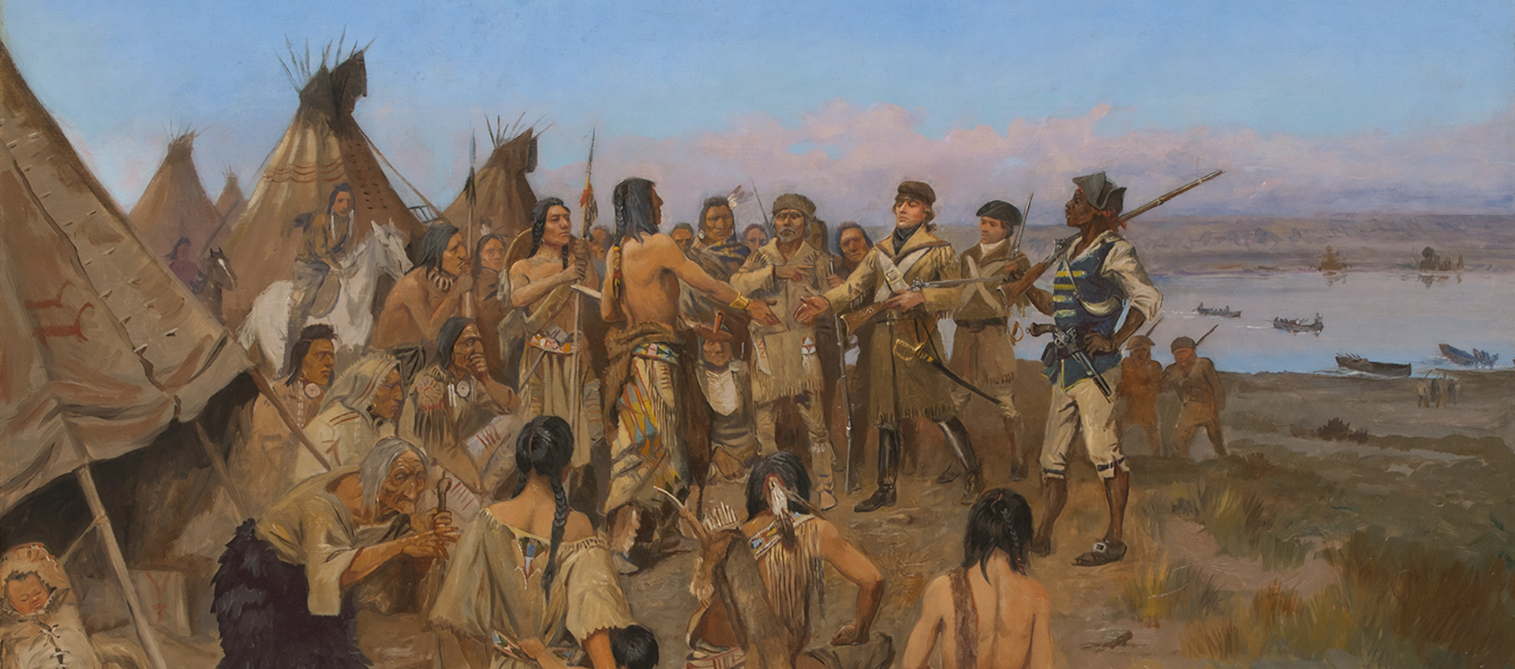
It was during its service with the Corps of Discovery that the Girandoni came into its own. Whenever a new tribe was encountered by the expedition, Lewis and Clark staged a grand entrance calculated to impress (or intimidate) the natives. Such pomp and ceremony, they believed, would dissuade potentially hostile actions by the Amerindians while they tried to understand who or what they were confronting. Lewis and Clark did their utmost to impress the tribesmen. According to the journal of expedition member Private Joseph Whitehouse the demonstrations to no less than 39 recorded tribes were a resounding success. For as much as the Indians coveted the guns and goods which the Corps of Discovery carried, none was bold enough to make an outright attempt at lightening the load of the intrepid explorers for fear of the incredible firepower that was on display.
At village after village, the small band of 38 explorers was allowed to pass safely without a single casualty through some of the most hostile and warlike peoples on earth, and the famed Lewis & Clark expedition completed its mission with only a single fatality and success beyond the wildest dreams of President Thomas Jefferson.
The rifle faded into obscurity for some time, but was rediscovered by Dr. Robert Beeman, the founder of the prestigious Beeman Precision Airgun company, when his passion for collecting air rifles led him to acquire a Girandoni in particularly good condition which was soon discovered to be none other than the the very weapon that accompanied Lewis and Clark on their expedition. Recognizing its historical significance, Beeman donated it to the U.S. Army War College in Carlisle, PA, and it is now on loan and on special display at the Pentagon.