
FORGOTTEN FIREARMS:The Golcher Swivel Barreled Flintlock
— NFCT Editorial Staff —
Want to learn more? watch an excellent video on similar such weapons produced by the YoutTube channel, Forgotten Firearms
Forever destined to be an undisputed icon of American resistance to tyranny in the annals of the American Revolution, is the Pennsylvania long rife. As the standard issue weapon of Dan Morgan’s riflemen, it is a legendary firearm to gun lovers and history buffs alike. But there existed a far more rare and more sophisticated weapon that struck a unique and special brand of terror into the hearsts of the British and their allies.
This was the Double-Barrel Over-and-Under Swivel Rifle, and in the hands of the legendary marksman Timothy Murphy, and other “special operators” of the period, it became a piece of colonial engineering that bridged the gap between frontier survival and high-stakes military intervention.
The Golcher Rifle and Its Origins
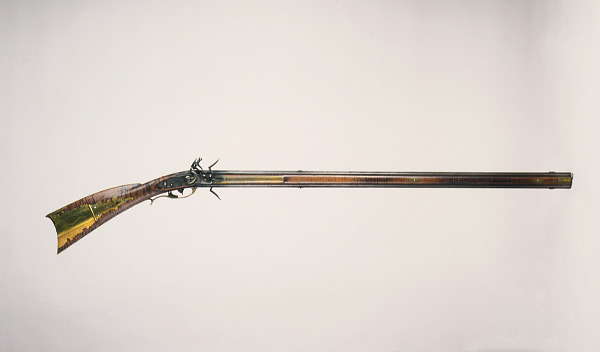
Designed and crafted by the master gunsmith John Golcher (or Goulcher) of Easton, Pennsylvania, this wasn’t your standard-issue Continental musket. At a time when a single shot followed by a 30-second or longer reload was the norm, the Golcher Swivel Rifle offered a terrifying tactical advantage: the unheard of ability to deliver a second deadly shot within seconds of the first one.
The gun featured two rifled barrels stacked vertically. To operate it, the shooter would fire the top barrel, depress a spring-loaded lever on the trigger guard, and manually rotate the entire barrel assembly 180 degrees. This brought a fresh, primed barrel into alignment with the single flintlock mechanism.
The genius—and the “Achilles’ heel”—of the Golcher was the swivel-breech. It required watchmaker-level precision to ensure the flash pan of the second barrel stayed sealed while rotating. If the tolerances weren’t perfect, the priming powder would spill out, leading to a literal “flash-in-the-pan” at the worst possible moment.
Carrying two heavy octagonal steel barrels on a single stock was a physical trial. Most frontier rifles weighed 7–9 lbs; But Golcher rifles tipped the scales at over 10 lbs. It was a specialist’s tool, meant for those men who prioritized raw firepower over lightweight mobility.
As one might expect, such specialized and high-tech weapons were rather expensive to the point of being unobtainable for the common soldier. Yet during the pinnacle of its popularity, records show that a market had developed for the Golcher among those who could actually afford one.
Novelty and Notoriety
Men like Timothy Murphy and scouts in particular, though rarely if ever men of means, were akin to special operators today, and as such were entitled to bounty money, and battlefield spoils. Making it a profession in which a resourceful man could actually acquire enough money to kit themselves with the finest weapons and tech available. And such was the case with the Golcher rifle. Murphy likely obtained the rifle he famously used to such great effect after Saratoga, when he married Margaret Feeck. She was the daughter of Johannes Feeck, one of the wealthiest patriots in the region. The Feeck family lived in a fortified stone house and owned vast acreage. A custom-ordered Golcher swivel rifle—costing the equivalent of several months’ salary—was almost certainly a “life insurance policy” provided by his new father-in-law to ensure the valley’s most effective defender stayed alive during the period brutal Tory raids in the region.
There is more than ample reason to believe that the Golcher rifle had become the weapon of choice for many elite scouts at that time.
Gunsmithing records from the Easton district reveal that while standard rifles were mass-produced, “swivel-breech” orders were specifically tied to independent scouts and wealthy frontiersmen. These were men who operated outside the standard “linear” warfare of the Army and unconstrained by army policy, had a free hand to seek out and avail themselves of more specialized and innovative weaponry that would give them a tactical edge.
In journals from the 1780 attack on the Middle Fort, Tory observers frequently mentioned the seemingly “supernatural” rate of fire coming from American scouts. The ability to hold a second shot in reserve that the Golcher provided, preventing the user from being rushed while reloading would wind up giving the gun a sort of mythic status as a “supernatural” weapon.
With British soldiers cubbing it a “devil gun” and it Amerindian warriors being so unnerved by it, that they sometimes referred to it as a “spirit gun.” With an abundance of accounts attesting to this, it is tempting to wonder whether the gun was more deadly to the mind or the body.
The Gradual Slide Into Obscurity and Obsolescene
All of this begs the question: If the swivel rifle was so effective and popular among scouts, why did it disappear?
Like most early innovations in high tech weaponry from this period, The Golcher rifle had its share of drawbacks:
The “Gunk” Factor: Black powder is a filthy propellant. After just three or four rotations, carbon buildup (fouling) would often jam the swivel mechanism, turning a high-tech marvel into an expensive, two-barreled club.
The Percussion Wall: The final blow was the ignition. A swivel-barrel flintlock required two separate flash pans and frizzens, doubling the risk of damp powder. When the percussion cap arrived in the 1820s, gunsmiths could finally build fixed double-barrels that were slimmer and more reliable. The “mechanical gymnastics” of the Golcher became obsolete overnight.
In spite of this, suriving specimens of Golcher rifles such as those held by the Schoharie County Historical Society and the Smithsonian show heavy “field wear” on the swivel mechanisms. Proving that up until their obsolescene, these weapons saw extensive service.
The Legacy of a Forgotten Firearm
Today, the Golcher Swivel rifle represents the pinnacle of American frontier ingenuity and is often overlooked as one of the many early innovations in guncraft that though forgotten, served not just the men who defied an empire in defense of home and hearth and their liberties, but as stepping stones to the AR-15 and other platforms in common use today. Contrary to the popular talking point of gun control advocates, The Founding Fathers didn’t just know of such weapons but sought after them at various times. The Golcher rifle survives today not just in lore and annals, but in museums around the country.