
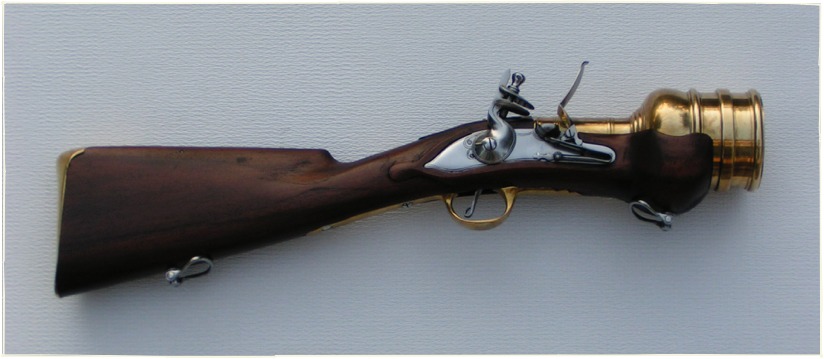
FORGOTTEN FIREARMS: The Flintlock Grenade Launcher
— Jacob Tyler —
American history is far more remarkable than people realize. That’s saying a lot, to be sure, but beneath familiar tales of flintlock muskets and stroic minutemen lies a history of daring innovation and intrepid tenacity that not only had a direct bearing on the course of the Revolutionary War, but would help to influence the very formation of our our national character.
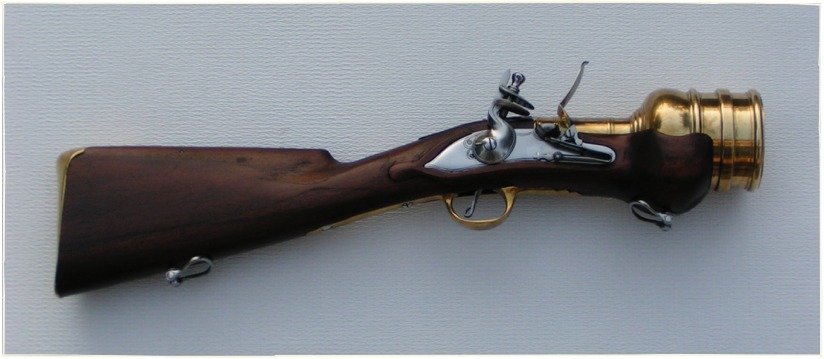
Known more commonly as a “hand mortar” the flintlock grenade launcher is a rare artifact from an age where inventive spirit went muzzle to muzzle with the accepted military doctrines of the pre-eminent world superpower of its time; and unlike most of the soldiers from that era who dared to fight the British in open battle, emerged triumphant.
Although it may look like something from out of a Steampunk novel, this all-but-forgotten weapon is far from a figment of speculative fiction. These remarkable guns were coveted by both naval and land forces for their potential to turn the tide in siege and close-quarters engagements.
Primary source documents from the period, such as the 1776 request from the Continental Army Ordnance Department, record explicit orders for hand mortars and associated ammunition. Naval logs from vessels, including one under the command of Captain John Paul Jones—the courageous seafarer who famously retorted to the British commander whose ship had nearly reduced his own to splinters “I have just begun to fight!” (when asked to surrender) moments before boarding the British ship and overwhelming its crew in hand-to-hand combat— confirm their use, notably during ship-to-ship actions against British forces.
While rare, the hand mortar’s reputation preceded it. There are numerous letters still existing today from officers who requested more of these “engines for lobbing grenadoes,” and British reports described being subjected to “most ferocious devices of American invention.”
As one would expect, this early grenade launcher was almost as hazardous for its wielder as it was for those it was wielded against, yet the risk of misfire or user error did little to dampen demand; rather, the hand mortar’s mystique grew with each account of dramatic successes on ships and in desperate last stands, where even a small number in the right hands could wreak havoc among organized ranks or disrupt fortified positions.
That the colonials possessed such rare and formidable tools is not just an unexpected and isolated detail in American revolutionary history—it stands alongside a litany of emerging and innovative arms from the era, that included the Ferguson Rifle (a breechloader capable of astonishing rates of fire for its day), the Girandoni Air Rifle (a repeating air gun that awed contemporaries by firing multiple shots without smoke or flash), and even multi-barreled volley guns or the legendary Puckle Gun (a precursor to the machine gun).
While none of these saw widespread issue due to cost, complexity, or the hazards of frontier supply, documented examples turned up in Continental arsenals, battlefield after-action reports, and in the personal effects of prominent leaders. Indeed, Thomas Jefferson himself praised the systematic acquisition and improvement of cutting-edge arms, commissioning surveys of foreign innovations and authorizing the importation of advanced artillery and small arms during his tenure as governor of Virginia.
The cumulative evidence—drawn from letters, inventories, memoranda, and firsthand narratives—unambiguously refutes the modern claim that the Second Amendment was crafted with only hunting in mind or in a technological vacuum. The Founders were acutely aware of the existence and potential of advanced, even fearsome, weaponry. Their correspondences make it clear that an armed populace was a practical—not merely ideological—safeguard against tyranny. That at the beating heart of the right to keep and bear arms enshrined in our 2nd ammendment is the principle that it is a citizen’s sacred right to be equipped with whatever arms might allow them to stand on equal footing in defense of freedom itself.
This context is all the more relevant when we consider that the American Revolution was, from its outset, a struggle of ordinary people against a superpower whose military and technological advantages were widely considered insurmountable.
It also informs contemporary debate as Americans grapple with questions of government overreach and the looming threat of a system that ever since the days of the American Civil War has grown increasingly disposed towards the use of violent coercion of its own populace, when opposed.
Over the course of this series, we will delve into each of these revolutionary weapons—the Ferguson Rifle, the Girandoni Air Rifle, the Puckle Gun, and many others—exploring not just their technical specifications, but their place in the grand drama of liberty and the ongoing discussion of what it truly means to be armed in America and the full scope of what “shall not be infringed” truly means.